
Nate Eaton

Course

Bodybuilding 101 Seminar: Prep & Posing

A supportive place to learn prep and posing, whether you are just starting to think about the stage, you have competed before, or you coach others.

Syllabus

Date
TBA
Location
TBA
Price
TBA
Refunds
TBA

Flyer

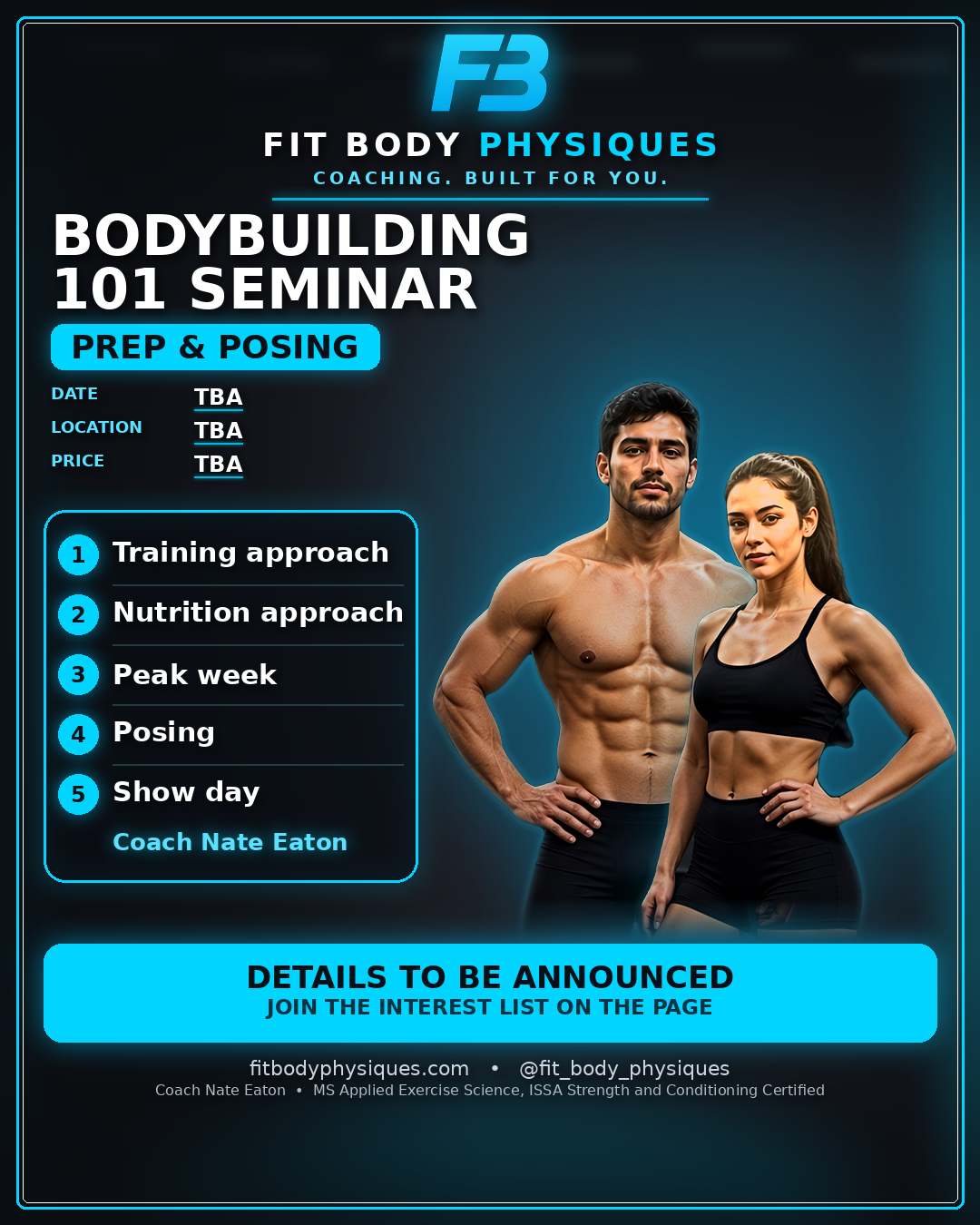
Bodybuilding 101 Seminar

Bodybuilding 101 Seminar flyer: Prep and Posing with Coach Nate Eaton, featuring two bodybuilding competitors. Date, location, and price to be announced.

About this seminar

What to expect

I've been on both sides of this sport. I competed and I hold pro cards, I'm a certified bodybuilding judge for multiple organizations, and I've promoted bodybuilding shows for about 10 years. I also know what a big change feels like — I lost about 150 lbs from my heaviest to stage weight. I hold an M.S. in Applied Exercise Science (2016), and I'm ISSA Strength and Conditioning Certified.

My hope for this seminar is simple: you leave with a clearer picture of prep and posing, and you feel supported doing it. You don't need a show on the calendar. You don't need to have everything figured out. This room is open to everyone, whatever federation you're considering — tested or untested — and whatever your training and recovery look like. You're welcome here.

Who it's for

A mixed room, on purpose

This seminar is built for a mixed room, and that's on purpose. We'll move at a pace that makes sense if this is brand new, and still give enough depth if you've already been on stage or you coach other people.

First-timers

If you've been curious about competing and don't know where to start, this is a gentle, practical introduction. We'll talk through the process in plain language, and you can ask the questions you've been holding onto.

Returning competitors

If you've done a show and want a cleaner posing presentation, a clearer feel for prep, or a smoother show day, there's room for you too. We'll work on the details that help you present the physique you've already built.

Coaches

If you guide clients toward the stage, you're welcome to sit in, take notes, and tighten how you explain the process. This isn't a coaching certification; it's a working overview you can take back to the people you work with.

Every division is welcome — bodybuilding, classic physique, men's physique, women's physique, figure, wellness, bikini, and any other physique category you're considering. You don't have to have your division picked yet.

The curriculum

What we'll cover

We'll work through the parts of prep and posing that usually raise the most questions, with time to practice and time to ask. This is about the approach — not a one-size plan, and not a list of calorie or macro targets.

How prep works

How a typical contest prep unfolds, how off-season and prep differ, and how to think about timing if a show is still just an idea.

Training during prep

How to keep strength in the picture, when volume or intensity may need to shift, how cardio usually fits in, and why recovery matters more as the weeks go on.

Nutrition approach and check-ins

A gradual deficit, protein as a priority, and how adjustments get made from regular check-ins. We'll talk about refeeds and diet breaks as tools some people use — not as a prescription, and not with set numbers. Everyone is individual.

Peak week, in concepts

What the final week is actually trying to do, and why drastic last-minute changes are not the approach we'll teach. This is an overview, not a personal protocol.

Posing and stage presence

Mandatory poses for your division, transitions, a practice routine, and the little details — hands, feet, posture, expression — that help your physique read clearly. We'll practice, not just watch.

Show day and after the show

Tanning, suits, what to pack, backstage flow, and how judging typically works. We'll also talk about post-show recovery and easing back toward off-season, plus dedicated time for questions.

Seminar outline

How the day is organized

This is a working outline of a typical seminar day. Date and start time are still to be announced, so the parts below are sequenced, not locked to a clock. Once the date and location are set, I'll share the final timing with everyone who registers.

You'll hear guidelines for the approach — how prep, training, nutrition, posing, and show day usually work — not a plan written for one body. Intake amounts and exact macros are not part of this seminar, because those need to be individual. What works for the person next to you may not be what works for you, and that's okay.

This seminar is educational. It is not individualized medical, nutrition, or training advice, and it is not a substitute for working with your physician or a qualified professional who knows your health history.

Part 1

Welcome and how prep works

Timing TBA

  1. Welcome and check-in

    • Get settled, meet the group, and share (only if you want to) where you're starting from.
    • How the day will flow, when we'll take breaks, and how to get the most from the posing block.
    • A simple reminder: you don't need a show on the calendar, and you don't need to have everything figured out.
  2. How contest prep actually works

    • What "prep" means in plain language, and how it sits inside a longer year of training.
    • Off-season versus prep: what usually stays the same, and what typically changes.
    • Building versus revealing: using the off-season to get stronger and add quality muscle, then using prep to gradually bring the physique into show condition.
    • How to think about choosing a show date, and how long a prep often runs — with the honest caveat that the right timeline depends on where you're starting.
    • Who this journey can be for, and how to decide whether a show is the right next step for you.

Part 2

The prep approach

Timing TBA

  1. Training during prep

    • The goal in prep is usually to keep the muscle you've built, not to overhaul your entire program.
    • Keeping strength in the picture: training with intent, rather than switching to "light and toned" just because you're dieting.
    • Volume and intensity: how sessions may be adjusted as energy and recovery change, without abandoning the work that maintains muscle.
    • Cardio as a tool, not the whole plan: starting with what's already sustainable, and adding only as needed.
    • Recovery as part of the program: sleep, rest days, stress, and listening when performance or mood starts to slip.
    • Why this looks different from person to person, and from early prep to the final weeks.
  2. Nutrition approach — without the numbers

    • The big idea: a gradual energy deficit over time, not a crash, and not a copy-and-paste meal plan.
    • Protein as a priority, with carbohydrates and fats supporting training, recovery, and how you feel — in proportions that fit the individual.
    • Why we won't assign calories or macros in the room: those need to be set for you, not borrowed from someone else.
    • Adjustments based on check-ins, not on one stressful day on the scale.
    • Refeeds and diet breaks as concepts — planned periods of more food that some athletes use to support training, adherence, and recovery. They are tools, not a requirement, and they are not a free-for-all.
    • Common sticking points, and how to think about them without panicking or making a huge cut all at once.
  3. Check-ins and progress tracking

    • What a useful check-in usually includes: weekly weight averages, photos, measurements if they're helpful, training performance, steps or cardio, sleep, hunger, mood, and how well the plan is being followed.
    • Why the whole picture matters more than any single number.
    • How small, one-at-a-time adjustments are made when the trend stalls — and when the answer is to stay the course.
    • How competitors and coaches can use this process together, including if you guide other people.

Part 3

Peak week, the stage, and after the show

Timing TBA

  1. Peak week approach

    • What peak week is trying to do: a little polish on work that is already mostly done.
    • The mindset I want you to leave with: the months of prep do the heavy lifting. The last week is not a magic trick.
    • Why drastic last-minute changes — including aggressive water or sodium swings — are not the approach we'll teach. Those can leave you flat, depleted, or unwell, and they are not required for a sharp look.
    • Concepts only: how training, food, posing practice, tanning, and stress usually get simplified in the final days, without a one-size protocol.
    • Show-day eating in principle: familiar foods, staying comfortable, and not experimenting with something new under the lights.
  2. Posing for your division

    • Mandatory poses and quarter turns, grouped by the divisions in the room — bodybuilding, classic physique, men's physique, women's physique, figure, wellness, bikini, and any other category represented.
    • Transitions: how you get from one pose to the next without rushing or losing your shape.
    • Building a simple practice routine you can keep using after you leave.
    • Stage presence: the walk-on, how you hold a pose, expression, hands and feet, and staying composed during comparisons.
    • Hands-on practice and individual feedback. If you have a suit or trunks, this is a good time to wear them; if not, comfortable posing clothes are perfect.
  3. Show-day logistics

    • A walk-through of a typical contest weekend: athlete check-in, wait times, prejudging, the gap before the night show, and awards.
    • What judging is usually looking at, and how comparisons tend to run, so the stage feels less like a surprise.
    • Tanning, suits or trunks, heels if your division uses them, and the finishing details that often get left until the last minute.
    • What to pack: the practical list (suit, extras, toiletries, snacks you already tolerate, bands for a pump, and the documents the promoter asks for).
    • Backstage: lining up, pumping up, listening for your class, and taking care of yourself in a long, sometimes stressful day.
  4. After the show

    • Why the days and weeks after a show need a plan, just like prep did.
    • Easing back toward off-season: restoring energy, reducing the pressure, and returning training toward building again — at a pace that fits you.
    • The emotional side: appetite, body-image swings, and the "now what?" feeling a lot of people have. You're not the only one.
    • How to think about the next goal, whether that's another show or a longer season of training, with no pressure either way.
  5. Open Q&A

    • Anything we didn't get to, including questions about coaching, clinics, or what to do next.
    • No pressure to sign up for anything else.

Before you arrive

What to bring and wear

  • Clothes you can move and pose in. A competition suit or trunks if you have them; otherwise, fitted shorts and a sports top or sports bra work well.
  • If your division uses heels, bring your stage heels or a comfortable practice pair.
  • Water, and any meals or snacks you need to stay on your plan. We'll take short breaks.
  • A notebook or a notes app, and any questions you've been wanting to ask.
  • An open mind. You don't have to perform or have anything figured out before you arrive.

You do not need a tan, a finished suit, or a show entry to attend.

When you leave

What you'll leave with

  • A clearer picture of the prep process, and whether competing makes sense for you right now.
  • Hands-on posing practice and personal feedback on your presentation.
  • A practical sense of show-day flow, suits, tanning, and the details that make the day smoother.
  • Answers to your questions, in a room that's meant to feel supportive.
  • A simple sense of possible next steps — more posing practice, coaching, or simply more time to think — with no pressure to sign up for anything else.

Questions

FAQ

Do I need to have a show picked out?

No. Plenty of people come to a seminar like this just to learn. If you already have a date in mind, we can talk about how to work backward from it. If you don't, that's completely fine.

I'm brand new. Will I be lost?

You won't. I'll start with the basics and build from there. First-timers are a big part of who this seminar is for, and you can ask anything, even if it feels obvious.

I've already competed. Is this too basic?

It shouldn't be. We'll cover foundations so everyone is on the same page, then spend real time on posing, presentation, and the finer points of prep and show day. If you've been on stage before, you'll still have things to refine.

Which divisions do you cover?

All of them, as the group allows. We'll give time to the divisions in the room and talk through how categories differ, so you can make a more informed choice if you haven't picked one yet.

Is this only for certain federations?

No. This seminar is open to everyone, whatever federation you're considering — tested or untested. If your training or recovery includes TRT, peptides, or another approach, you still belong in this room. I want this to feel welcoming, not exclusive.

Will I get individual posing feedback?

Yes. The posing block is hands-on. I'll watch you, make adjustments, and help you practice what to work on after you leave.

What's the date, location, and price?

Those details are still to be announced. If you join the interest list, I'll send a note when seats open. There's no obligation to register.

Can I come if I coach other people?

Yes. Coaches are welcome. You'll hear the same material as everyone else, and you're free to take notes you can use with your own clients.

Policy

Refunds and cancellations

If you need to cancel 14 or more days before the seminar, I'll refund your registration in full. If you cancel fewer than 14 days before the event, I can't offer a cash refund, but I'll hold what you paid as a credit toward a future Fit Body Physiques seminar or posing clinic. If I cancel or reschedule the seminar, you'll receive a full refund, or you can move your seat to the new date if you'd rather. If you don't attend and don't get in touch, the registration isn't refundable.